

Blog · Leafcutter Bees · Mason Bees ·
Happy Valentine's Day!

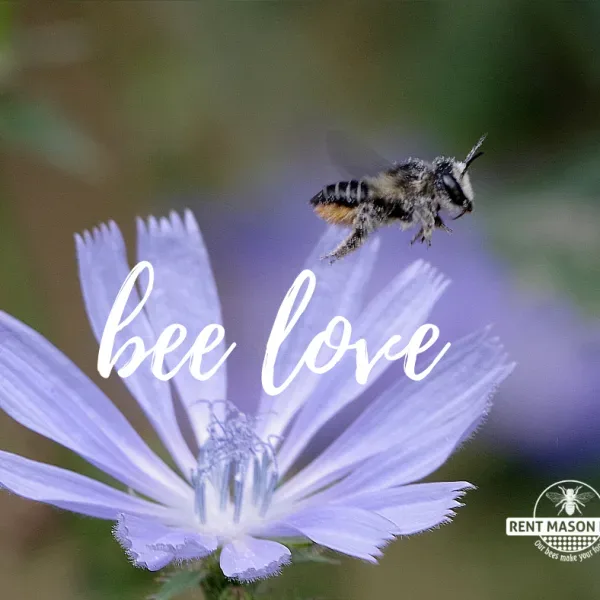
 To celebrate Valentine’s Day, our Bee Biologist shares a bee love story.
How I Came to Know and Love Bees
By Morgan Dunn, Rent Mason Bees
Before I became a bee biologist, the iconic honey bee would come to my mind when I heard the word ‘bee’. I thought of golden honey, a Winnie-the-Pooh-style nest, and fields of summer flowers. Growing up in North Carolina, I also knew of carpenter bees which would leave those perfectly circular holes in wooden patios. And of the tiny, shiny sweat bees that I would watch with fascination as they crawled around and tasted surfaces of my skin.
After receiving my degree in Wildlife Biology, I landed a summer job doing ecotoxicology research with honey bees. The first day on the job was my first experience inside of a honey bee colony. That summer, I handled several hundred colony bee colonies and was dealt countless, painful stings, but I loved it. Working with a honey bee hive is thrilling and endlessly fascinating. No matter how many times you may have opened up a hive, there’s always a chance of seeing something new. The hive really does seem to function as a superorganism, working in an extremely complex and mysterious, yet, somewhat predictable way.
As my summer job came to an end, my growing passion for bees led me to keep bee hives of my own. From my co-workers, I had learned a little about other types of bees and insects, but I was eager to know more. Luckily, a technician was needed to process the hundreds of samples collected from experimental crop plots, and I was hired.
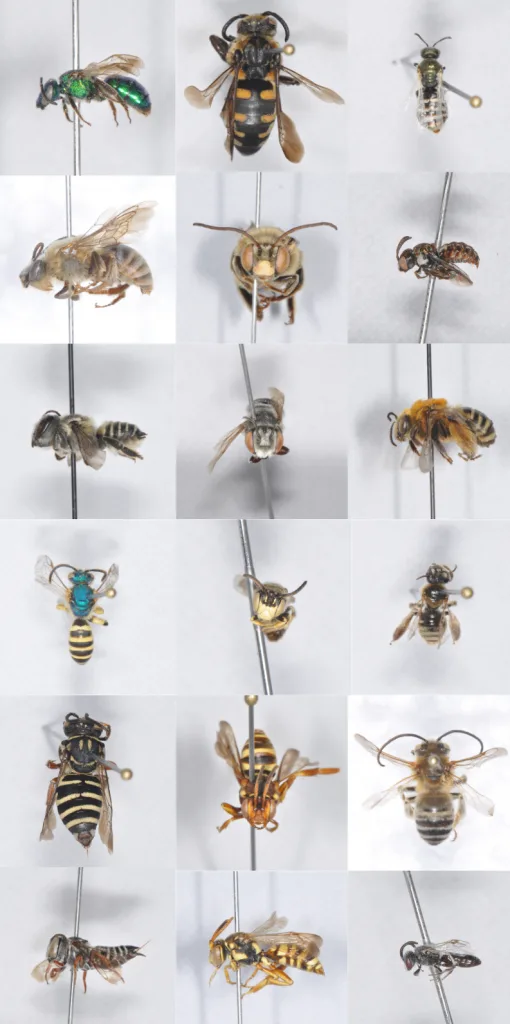 I knew my first big task at my new job was curate these “non-Apis” (aka, not honey bee) samples from a two research experiments. A large portion of this job was to wash and dry samples of bees that were collected in the field and mounting them on insect pins so they can later be identified to species. Since there are over 20,000 bee species worldwide, it’s usually necessary to look at bees under a microscope in order to identify them. And so, for the first time, I did just that.
I was stunned, mesmerized, befuddled. Each bee flaunted a brand-new suit of colors, textures, and shapes for my eyes to explore. I saw branched, feather-like hairs, perfectly adapted for catching tiny grains of pollen. A sea of punctations across iridescent exoskeletons, sparkling like uncut gemstones. I learned some key features to looks for, like distinct hair patches, spines or other unique protuberances, color patterns, etc. to help identify bee species. Each bee I saw was so beautifully complex and unique that I had to learn more. I spent much of my free time reading research papers on a bee I had encountered for the first time that day or about bee biology in general.
For me, studying bees satisfies all the reasons why I have chosen to dedicate my life to studying to natural world. Bees have coevolved with flowering plants since their dawn; they are essentially wasps specialized to take advantage of an emerging food source – pollen and nectar. Bees have long played a fundamental role in propagating one of the most successful forms of life on this planet – flowering plants. These complex relationships have led to extraordinary adaptations and behaviors that can be found across the world, from the tropical orchid bees to the desert-dwelling bees. These relationships perpetuate entire plant communities and have provided essential nutrients to human diets since our beginning.
We owe much to bees. But ultimately, everything we owe to them, we also owe to the flowering plants which feed them and in turn feed us. And to the sun and the soil which fuels everything.



